

The Best Heroku Alternatives in 2026

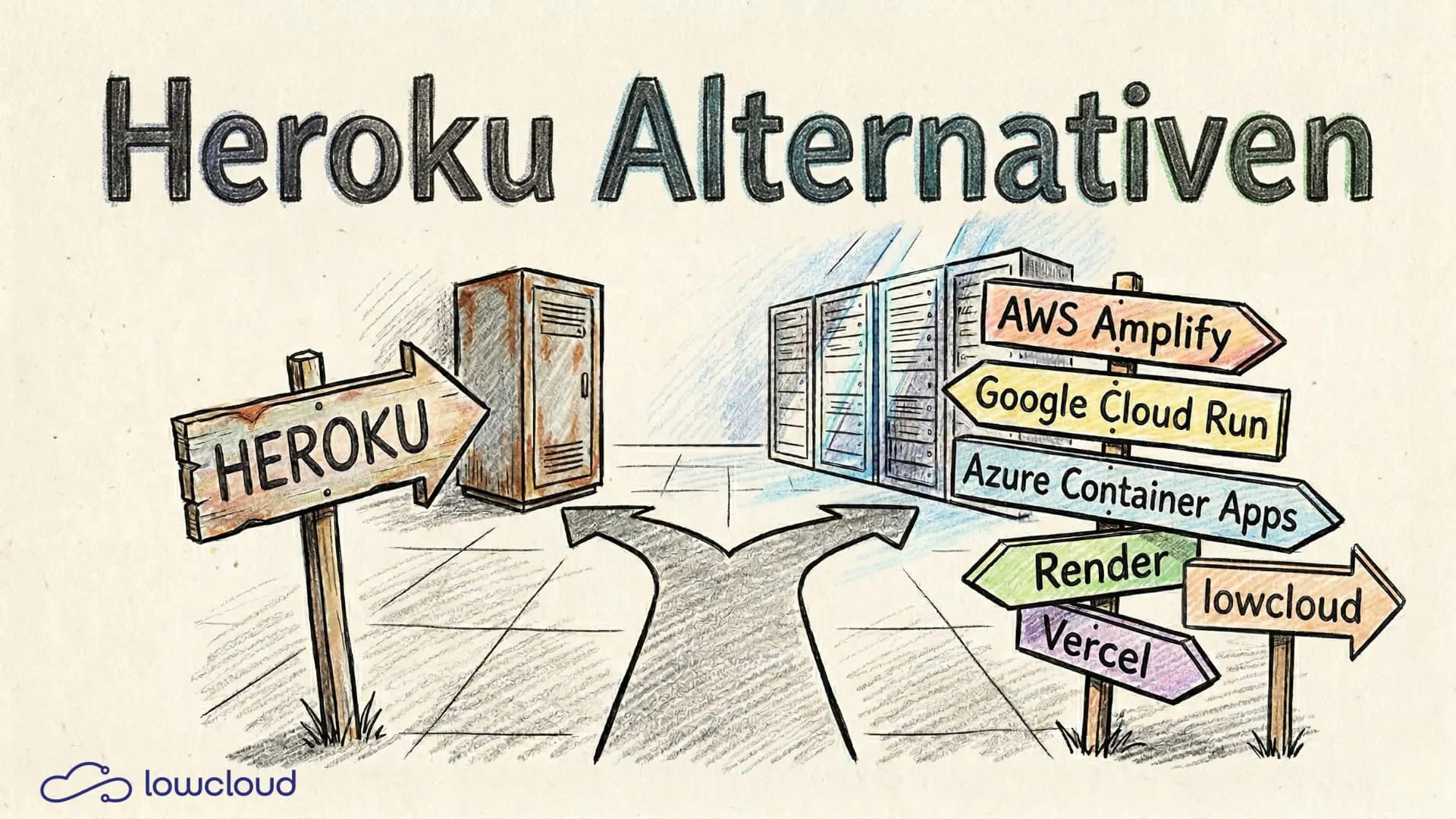
The Best Heroku Alternatives in 2026: What Actually Makes Sense Now
For many developers, Heroku was their first real introduction to the idea of getting an app into the cloud without any ops knowledge. That promise shaped an entire generation of web developers. Now Heroku is in maintenance mode. No new features, no active development, an unclear roadmap. For teams that have built on Heroku, that's a signal you shouldn't ignore.
This article shows which alternatives exist, what they can do, and what to watch out for when switching.
What is Heroku?
Heroku is a Platform-as-a-Service (PaaS) that lets you deploy and run web applications without having to manage your own servers or Kubernetes clusters. Apps are typically built and rolled out directly from a Git repository; configuration runs through environment variables, and typical add-on services (such as databases or queues) are connected as add-ons.
At its core, Heroku abstracts infrastructure into the simplest possible operating model: applications run in isolated units (dynos), scaling happens by spinning these dynos up and down, and the platform ecosystem takes a lot of operational work off teams' hands.
What Heroku Maintenance Mode Means
Heroku has been part of Salesforce since 2010. For a long time, the platform was the gold standard for fast deployment without infrastructure overhead. But for years, signs have been piling up that Heroku is no longer an internal priority: the free dynos were shut down, prices went up, the roadmap kept getting thinner.
The shift to maintenance mode is the formal confirmation of what many people have felt for a while. Concretely, here's what it means:
- Existing workloads will keep running – there's no forced immediate shutdown date.
- No more new features. The platform isn't being developed further.
- Support will be reduced. When something goes wrong, you're more on your own.
- Security patches will still be delivered for a defined period, but the horizon is limited.
For production systems that depend on reliability, that's not a sustainable state in the long run. Teams that migrate now have time for an orderly transition. Teams that wait will eventually migrate under pressure.
Why Many Teams Loved Heroku and What They Expect from an Alternative
Before looking at the alternatives, it's worth understanding what Heroku actually got right. Because not every "modern PaaS" delivers the same experience.
Heroku's core strengths were:
- Git-based deployment – no Docker knowledge required, no CI/CD setup needed.
- The Procfile concept – simple but powerful for defining process types.
- The add-on ecosystem – databases, queues, monitoring provisioned with one click.
- Dynos as an abstraction layer – no servers, no container concepts visible to developers.
- A zero-config experience – from code to URL in minutes.
A good alternative doesn't have to replicate all of that identically. But it does need to offer a similarly low entry barrier while being scalable enough that you don't have to switch again in two years.
The Best Heroku Alternatives in 2026 at a Glance
Today there's a whole range of platforms positioning themselves explicitly as a Heroku replacement. The quality varies widely. Here are the options that are relevant for the majority of teams.
Render
Render is probably the most direct Heroku alternative. The platform offers automatic deployments from Git, supports web services, workers, cron jobs, and static sites, all from a single UI. The developer experience is good, the documentation is solid.
Strengths: Active development, a good free tier for smaller projects, simple configuration.
Weaknesses: Pricing escalates quickly with larger workloads. The add-on ecosystem is limited, and you have to wire in external services yourself. Managed Postgres is available, but the overall selection of managed services is smaller than Heroku in its prime.
Fits for: Teams that want a fast migration and primarily run Node.js, Python, or Ruby services.
Railway
Railway has built up a loyal developer community over the past few years. The deployment model is similar to Heroku's, the interface is modern and visually polished. Railway supports deployments from GitHub, Docker, or your own templates.
Strengths: Very fast setup, intuitive dashboard, good support for various runtimes. The pricing model based on actual resource usage is fair for smaller teams.
Weaknesses: Still relatively young for enterprise use. Regional flexibility is limited; anyone tied to EU-only or specific compliance requirements will hit walls quickly.
Fits for: Indie developers, small teams, prototypes, and staging environments.
Fly.io
Fly.io is technically a different category. The platform deploys containers globally to edge locations. That means low latency for global users, but a different mental model from Heroku.
You deploy and Fly.io distributes the containers across multiple regions. That's powerful, but also more complex. Anyone who loved Heroku for its simplicity will have to do more configuration with Fly.io initially.
Strengths: Excellent performance for globally distributed applications, fair pricing for smaller instances, a strong CLI.
Weaknesses: The level of abstraction is lower than with classic PaaS platforms. There's a learning curve for teams without container experience. GDPR compliance comes with caveats since data may live on US infrastructure.
Fits for: Teams with container experience that want to optimize for global latency.
Porter
Porter is interesting for teams that actually want to be on Kubernetes but don't have the ops capacity to operate a cluster themselves. Porter provides a Heroku-like interface on top of Kubernetes infrastructure, either on your own AWS/GCP/Azure account or as a managed service.
Strengths: Kubernetes-native, full flexibility on the infrastructure side, a Heroku-like deployment experience for the team.
Weaknesses: More expensive and more complex than pure PaaS options. Only really makes sense above a certain team size and workload complexity.
Fits for: Scale-ups that want to grow into Kubernetes without immediately building a dedicated platform team.
lowcloud
lowcloud is a DevOps-as-a-Service platform focused on European infrastructure and digital sovereignty. That means deployments run in German or European data centers, and GDPR compliance isn't an afterthought but part of the design. On top of that, lowcloud runs everything on the customer's own infrastructure (e.g. in their own cloud account or data center).
For organizations that work with sensitive customer data or have to meet regulatory requirements, that's a decisive difference compared to US-based providers. lowcloud offers a managed Kubernetes experience: teams deploy applications without cluster management overhead but get the full flexibility of Kubernetes underneath. Importantly, this isn't just "managed Kubernetes" — it's a fully managed platform with everything that goes with it, similar to Heroku.
Strengths: EU hosting, GDPR-compliant by design, Kubernetes-native without ops overhead, suitable for production workloads with compliance requirements.
Fits for: Companies in Germany and the EU, teams with data protection or compliance requirements, Kubernetes users who want a managed approach.
Sovereignty & Lock-in: Why the Infrastructure Question Matters
Many of the well-known Heroku alternatives are US providers or are heavily built on US infrastructure ecosystems. For organizations that take digital sovereignty seriously (e.g. due to data protection, regulation, risk management, or strategic independence), that's more than a detail: jurisdiction, control options, and dependencies become part of the technical decision.
There's a second point on top of that: classic PaaS offerings are convenient but often lead to lock-in. That doesn't just affect APIs and add-ons, but also buildpacks, deployment workflows, observability stacks, and the operating model. The more these platform-specific building blocks get used, the higher the cost of switching later.
Exceptions are mainly models where the platform runs on your own infrastructure:
- Porter can be operated on your own AWS/GCP/Azure account. That keeps infrastructure ownership with the company, and Kubernetes serves as a portable foundation.
- lowcloud goes one step further: the platform runs on German/European infrastructure and is designed for sovereignty. That combines infrastructure ownership (your own or a controlled environment) with a provider setup in Germany, with the goal of delivering PaaS-level convenience without the typical lock-in effects of classic, proprietary platforms.
Other Providers as an Alternative to Heroku
Beyond the options above, there are many other platforms that handle hosting, deployments, and sometimes backend functionality. This article deliberately focused on a few candidates that come closest to the classic Heroku experience ("push code, app runs") and represent a real alternative for many workloads.
Other commonly used providers include:
- Vercel
- Netlify
- Cloudflare Pages / Workers
- Firebase
- AWS Amplify
- Google App Engine
- Azure App Service
- DigitalOcean App Platform
- Elastic Beanstalk
Many of these offerings are either heavily optimized for frontend/serverless scenarios or part of large US cloud ecosystems. In practice, that often comes with the same two limitations as classic PaaS platforms: limited sovereignty (US provider/jurisdiction) and no operation on your own infrastructure (no deployment in your own account or data center). If that's exactly what you need, you typically end up with BYOC- or on-prem/private-cloud-capable platform approaches.
What Really Matters in a Migration
A migration off Heroku is rarely just copy-paste. Here are the points that take the most work in practice:
Replacing add-ons: Heroku's add-on marketplace is a central part of the platform. Postgres, Redis, RabbitMQ, S3-compatible storage — all of that has to either be offered as a managed service on the new platform or wired in externally. Before the migration, it's worth doing a complete inventory of all add-ons in use.
Translating Procfile logic: If Procfiles are in use, check how the target platform represents worker processes and release commands. Most modern PaaS platforms have equivalents, but the configuration looks different.
Environment variables: Sounds trivial, but it's error-prone. It makes sense to document all config vars before the migration and transfer them completely to the new platform.
Build and deployment process: Many teams have built up CI/CD pipelines over the years that hook directly into Heroku's Git integration. These have to be adapted, either to the new platform's deployment mechanisms or to a platform-independent, Docker-based deployment.
Logging and monitoring: Heroku Logplex is easy to use, but in a migration that integration is lost. So logging and alerting on the new platform should be reliably set up before go-live.
A staging deployment on the target system before the production cut-over isn't optional — it's mandatory.
Which Platform Fits Which Team?
There's no universally correct answer. But there are clear patterns:
Render or Railway are the right choice if the team is small, the workloads are manageable, and a fast switch with minimal effort is the priority.
Fly.io makes sense if global latency is a concern and the team already has container experience.
Porter is a good bridge for teams that want to grow into Kubernetes without immediately hiring a platform engineering team.
lowcloud is the choice for companies where EU data protection, GDPR compliance, or digital sovereignty are non-negotiable and that don't want to give up a developer-friendly deployment experience to get there. At its core, lowcloud combines several properties that are usually only available separately: the simple, Heroku-style handling and fast developer experience (as with Render or Railway), a Kubernetes foundation for portability and standardization, and operation on your own infrastructure (similar to Porter) instead of on a closed vendor platform. At the same time, the sovereignty aspect is preserved: setup and operation are aligned to Germany/EU, with the goal of avoiding lock-in and keeping control over data, infrastructure, and operating model with the customer.
If you're currently planning a Heroku migration, now is the right moment for a well-founded decision rather than a quick workaround. lowcloud offers a DevOps-as-a-Service platform built precisely for this use case: production-ready deployments on European infrastructure, without needing an ops team to do it. That makes it possible to evaluate early what lowcloud can do for your stack before migration pressure builds up.
What Is Kubernetes? A Practical Guide to Container Orchestration
What is Kubernetes and how does container orchestration work? Learn about K8s architecture, Pods, Services, auto-scaling, and when Kubernetes is the right fit for your project.
The Cloud Illusion: Why a Server Location in Germany Doesn’t Guarantee Digital Sovereignty
A German data center alone isn’t enough: How the US Cloud Act, Schrems II, and vendor lock-in undermine real data sovereignty – and how lowcloud closes the developer experience gap.